
Reflections on natural building in and out of the city
Wednesday, April 10, 2013
The making and UN-making of Dufferin Grove Park
I was a frequent park goer for many years, and during that time I was able, with staff's support, to lead volunteers in the creation of an outdoor kitchen made of cob. That free program was just one of many offerings that anyone finding refuge from the city in that 14 acre green space could partake in, regardless of ability, and at almost any time of the year.
It is amazing to me that the City of Toronto seems to have so much energy when it comes to imposing rules and restrictions, but no resources at all to put towards watching, listening and learning. The visionaries at Dufferin Grove Park have been sharing their ideas and successes for years – by publishing handbooks, newsletters and a website, and by inviting city managers to come and take a look – but the city seems to take an active disinterest in their efforts.
I think city staff and managers are probably similar to most people; we all just wish our jobs would go a little more smoothly. When we walk into our workplaces, we are looking for some ease in our transactions with our co-workers, our superiors, the public. I don't know anyone who relishes the possibility that their day is going to be full of cranky customers, stressed-out co-workers or demanding bosses. However, if people actually sat down and read their job descriptions, they would probably find that nowhere on that document does it say "Just get through the day as best you can". Instead, it might say, "Do your job", whether that's providing cable service or designing buildings or running a garbage truck. All of these tasks basically boil down to different ways of helping people.
A long time ago, I had an interesting experience that put things into perspective for me. As assistant stage manager (ASM) for a student variety show at university, I was tasked with placing and removing props, putting little pieces of glow tape on the stage to mark placement of objects and people, and other related duties. It was my first time as ASM, and I found it to be a stressful and not very gratifying job, filled with high-strung performers running around back stage, invariably in some sort of crisis.
At one point, a dancer came up to me and asked me to do some little thing for her; I quite forget what it was. I do remember thinking to myself, though, "Geez, she thinks this is all about her."
I stopped short when I realized that, geez, it was all about her. The audience was there to see her perform; they weren't there to see me move props on and off stage (though I was quick and stealthy so they probably couldn't see me during the black outs anyway even if they had been looking for me, which of course they weren't). My job was to be there for her so that she could be there for the audience, and whatever I could do to support that, was part of my job.
At that moment, I began to understand that, while it's ok, and even desirable, to find efficiencies in the way I work to make my job easier for me, that must never be mistaken for doing a better job. Only when the customer's cable is restored promptly, or a building is designed to meet a client's and the environment's needs, or the garbage is picked up on time and completely even though it was left out in a box instead of a bag (it would be ok to leave a friendly and educational note, for sure), could the job be seen as done.
I write all this to say that I think there is a cultural shift required within the city, so that it can see parks and recreation facilities not as places of employment, but as the vital nexus of citizen interaction that they are. Of course they are places of employment, but that in itself does not give meaning. Meaning comes from engagement and facilitation in order to enrich the lives of the citizenry, and make the city a place that people want to be in.
Do we want a city where citizens see themselves as part of a whole that they want to contribute to and benefit from? To get there requires active engagement from the city; the kind of engagement that Dufferin Grove Park is expert at. Come on, City of Toronto, what are you waiting for?

Tuesday, March 19, 2013
OSBBC & NBNE AGMs 2013

We'll see about that. In the meantime, I was pleased to attend this year's AGM weekend for both groups, held at Camp Kawartha, north of Peterborough. Here are some what I heard while there.
Building in a cold climate
This joint presentation from Jacob Deva Racusin (NBNE) and Henry Wiersma (OSBBC) talked a lot about issues that concern every builder in colder places, namely how to keep water away from your building: warm, moist air from below, rain and snow from above, and everywhere in between. The problem of animals eventually locating, entering and expiring in a foundation drain pipe that drains to daylight was discussed. Minks are apparently quite susceptible to this behavour (maybe it's a northern Vermont thing, I don't know). When minks plug up your foundation drain, you've got a problem. Building in a clean out to deal with this eventual clogging was suggested.Even better, a member of the audience posited, would be to build in redundancy in the system by putting in a couple, or even five, foundation drainage pipes and send them all to drain down hill. It's unlikely that five minks would end up clogging all of the drains at the same time. Problem solved, and no cleaning out of dead minks required.
My favourite idea from this talk though, was one I myself have had an abiding interest in. Since most natural homes don't have air conditioners nor electric clothes dryers, a possible target for energy use reduction could be the refrigerator. Henry asked, why would we have a machine that, in summer, pumps heat out out of an insulated box, only to dump it into our already-sweltering homes? Conversely, why have an energy hogging compressor run full bore to keep food cold in the winter, when we could harness the exterior temperatures to help, and even sometimes replace the compressor's work? Henry has placed his fridge on an outside wall, venting it outside. In his case, he has an expensive, off-grid Sun Frost refrigerator, and if I remember correctly, his compressor is located somewhere off in the distance; very wise. He included under-the-fridge, insulated drawers in his installation where he keeps several days' supply of onions, potatoes and carrots. This saves him the daily trek down to the root cellar.
I am going to be campaigning hard for this sort of arrangement in my next abode, though I imagine that I'll have some research to do as to which fridge might be amenable to working under these conditions.
Other tidbits
Retrofit: Mike Jones and his family gutted a balloon frame century home to do an interior straw bale retrofit, stacking them on edge. He also built a masonry heater using a kit from Crossfire for the core and hiring out the stone masonry.Rammed Earth: Tim Krahn from Natural Building Engineering Group showed images of some absolutely incredible rammed earth homes in Ontario that he's engineered.Maybe if you contact him he'll put some pictures up on his sight. You've got to see them.
Bale barn wrap: Dave Lanfear of Bale on Bale Construction talked about using the Plop-and-Pop method of straw bale construction, and said now fills any troughs at the top of walls – where the bales have sunk – with as-densely-as-he-can-pack-it, blown-in cellulose, instead of fiddling with straw stuffing.
Miscellaneous: Everybody's using Siga or Proclima tape now, says Jen Feigin of Endeavour. I think that's what she said, anyway. ~ Jacob Deva Racusin has a new book out called The Natural Building Companion that someone could get me for Christmas. ~ Chris Magwood suggested that soon, composting toilets will be accommodated in the Ontario building code, which is no doubt partially attributable to Endeavour's fine work on Canada's Greenest Home. Some of you may know of my own struggles trying to get a composting toilet approved for a downtown Toronto park, so this is welcome news to me. ~ Downtown Toronto can now name one straw bale house addition, thanks to Melissa Zytaruk and the Fourth Pig Worker Coop.
My sincere appreciation goes out to the Peterborough crew who organized this inspiring event and gave us a venue to share information, compare notes, cheer our successes and get help with challenges. I was reminded that it's not just the sustainable techniques that brought me this direction; it's mostly the people.
Wednesday, August 8, 2012
NBCNY 2012
Wednesday, June 22, 2011
Natural Building Colloquium East 2011
From my Peaceweaver family:
"From natural building to permaculture techniques to water and energy conservation...from alternative fuels to sourcing your food locally...this event is important for everyone who is concerned about how their lifestyle impacts our Earth.
Join us for the 2011 NBC - July 26-30 at Thunder Mountain!
This year's Natural Building Colloquium East: Building with Spirit will take place July 26-30, 2011 at Thunder Mountain Peace Sanctuary in Bath, NY.
The NBC is a fantastic opportunity to learn hands on natural building techniques from talented instructors from all over the country.
Workshops will focus on cob, strawbale, earthen plasters, timber framing and more. Come join us for a spirit filled event in the beautiful Finger Lakes region of NY.
Fee: $350 includes all workshops, camping, bathroom & shower facilities, and vegan meals. ($150 deposit due with registration. $200 balance due by July 8th.)
Please email the PeaceWeavers at pw@peaceweavers.com or call us at 607-776-4060 to sign up or for more info."
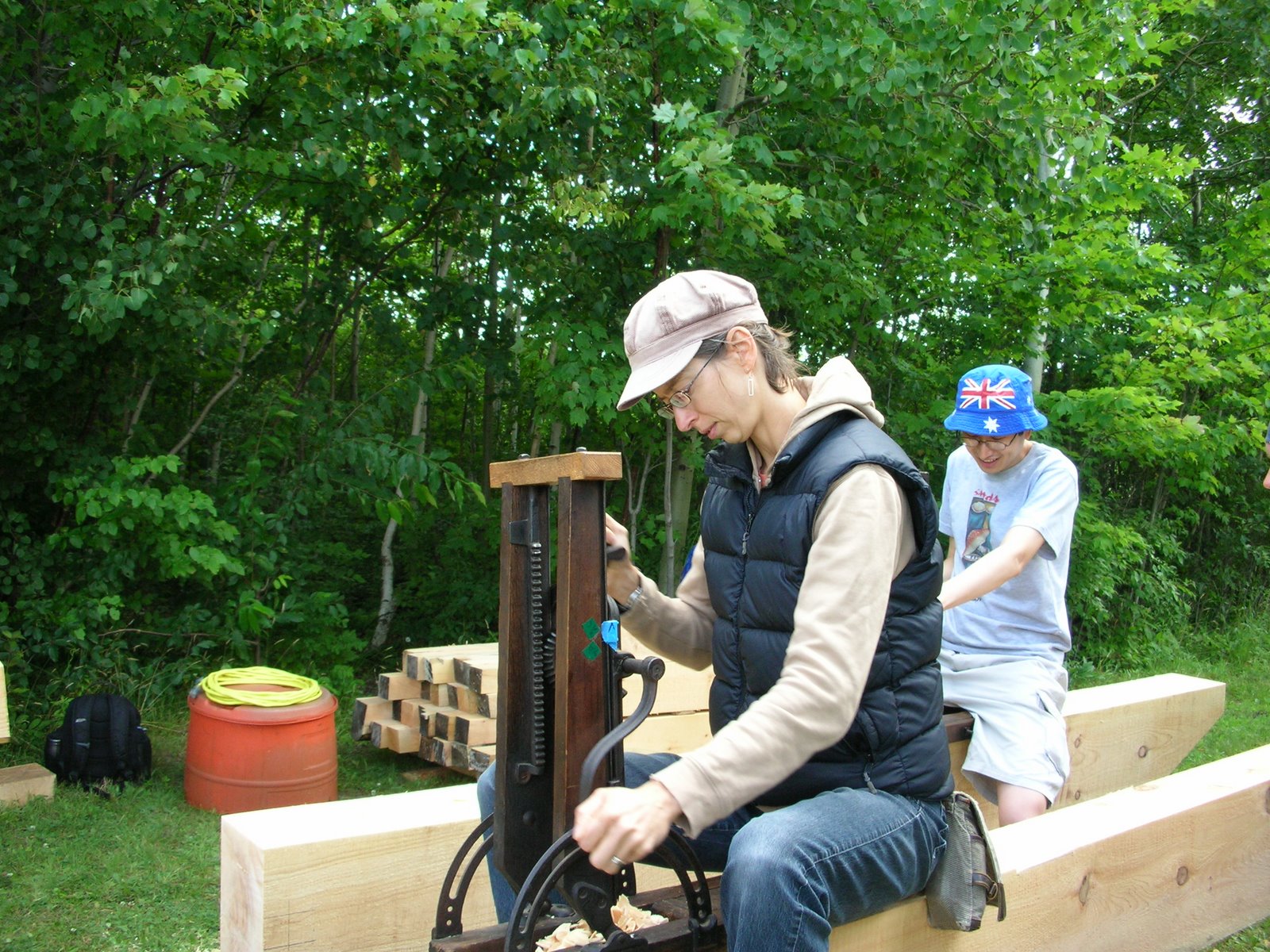
My photos from the 2010 colloquium are above.
Monday, June 20, 2011
Earthen plaster workshop
 Come join us for a weekend of fun and mud in Caledon East just north of Toronto this summer, as we apply earthen wall finishes to a timberframe/straw bale workshop. Topics covered will include sourcing and processing of ingredients, and their mixing and application, with an emphasis on hands-on learning. Tools and materials are provided. Please bring good work clothes and boots and rain gear and prepare for all to get muddy. Fee includes instruction, camping space, and meals. Kids are welcome! There is no separate child care, so please plan to keep an eye on your young 'uns. Contact me at muddygeorgie@gmail.com for more information and to register.
Workshop details:

Location: Caledon East
Date: Saturday, July 16 to Sunday, July 17, 2011, 9:00am to 5pm each day
- Plan on arrival for Friday night to allow for a quick start Saturday morning
Meals: Provided Saturday and Sunday
Accommodations: Camping (BYOTent and sleeping supplies)
Facilities: Indoor Washroom and Shower
Other activities:
- Saturday night: Communal meal, fire
- Sunday morning: Morning stretch
Cost: $200/participant
Accompanying Children: $20
*Discount of $50 per additional participant*
Photo by David Eisenberg
Feasibility study online
Thursday, October 28, 2010
Compost toilet feasibility study public consultations

Click on the picture to enlarge the image
The project to build a community-created earthen building and composting toilet facility in Dufferin Grove Park has been on ice since we completed the earthbag foundation in 2006. The City has recently contracted local architect Rohan Walters, along with me, some engineers and other professionals, with CELOS giving guidance, to go through the design and approvals process for the biotoilet project.
Next week, there will be information about the feasibility study and design proposals posted at the park in the rink house, the playground, and by the toilet foundation (aka Gossip Rock). Come to the meeting and make your voice heard; whether you are for or against, we want to hear what you think. In case you have forgotten the details, you can read background about the project here.
Subscribe to:
Posts (Atom)